



* Apple and the Apple logo are trademarks of Apple Inc., registered in the U.S. and other countries.
* App Store is a service mark of Apple Inc.
* Google Play and the Google Play logo are trademarks of Google LLC.

BrainTQ Information

WHAT’S BRAINTQ
What is BrainTQ?


Activate your brain in just 3 minutes a day.
Train your brain together with everyone
through PlayShare!
Play an ever-growing selection of mini-games and earn coins along the way. Save up your coins to meet new Brain Partners, unlock dance emotes, and more. With Play Share, you can easily create your own community and share your gameplay with others! BrainTQ is a brain-training app designed to make training fun and easy to keep up with—together!
Short Videos
Many more short videos of our training mini-games are available.
Watch more short videos here!
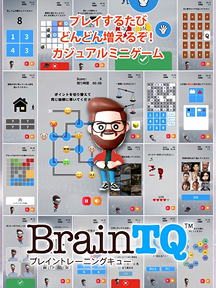
BrainTQ features more than 80 training mini-games.
And even more new games are added regularly through network updates!
By playing BrainTQ’s wide variety of training mini-games, you can easily and effectively train 8 fundamental abilities that form the core of thinking and perception—working together to help the brain understand and process information, make decisions, anticipate what comes next, and take appropriate action. These 8 abilities are Memory, Calculation, Spatial, Language, Prediction, Logic, Focus, and Visual, covering areas such as spatial awareness, predictive processing, logical thinking, concentration, and visual recognition.
In addition to regular training, BrainTQ offers a variety of play modes that make it fun and easy to keep training, including “Today’s Missions,” which presents you with different training challenges every day, and the “Weekly Time Challenge,” where you compete for the best times in around 10 selected games against BrainTQ players across Japan.
Through network updates, more and more training mini-games and entirely new training modes are being added!
Stay tuned as BrainTQ continues to evolve!

BrainTQ has a private AI agent called the “Brain Partner”, always by your side.
Your Brain Partner keeps track of your training progress and play results, compares them with your past performance, highlights areas you may want to pay attention to, and suggests a variety of training activities tailored to you. It can even give you hints in some games, supporting you in many different ways.
Always by your side, your Brain Partner provides reassurance and makes your training experience more enjoyable and engaging.
Private AI Agent
 embedded
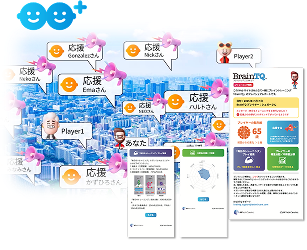
Through Play Share, you can easily connect with close friends, family members living far away, and other people who are important to you.
Your daily training report is automatically updated and shared with the people you connect with through Play Share.
The report compares your latest results with your past performance and provides gentle alerts, such as “Your memory score seems to be a little lower than usual.” Your connections can also send you “Support Coins” through your training report to cheer you on.
Play Share creates your own supportive community, gently watching over you. With BrainTQ, simply playing games can bring you a greater sense of reassurance.
8 Fundamental Brain Abilities
at the Core of BrainTQ
Activate your brain in just 3 minutes a day!
Brain entertainment training you can enjoy together
and keep up with every day.
That’s BrainTQ!

1

memory
Memory
2

calculation
Calculation
3

spatial awareness
Spatial Awareness
4

language
Language
5

Predictive Processing
Prediction
6

logical thinking
Logic
7

concentration
Focus
8

visual recognition
Visual Recognition


memory
Memory
A Fundamental Brain Ability That Connects Experience to the Future
Memory is one of the brain’s most fundamental abilities, involved in nearly every aspect of our daily lives. By learning new information and recalling it when needed, memory supports learning, work, relationships, and everyday decision-making.
Remembering someone’s name, recalling an appointment, or learning a new route—all of these rely on memory.
Academically, memory is generally understood to involve three main processes:
• Encoding: Understanding information and taking it into the brain
• Storage: Retaining information in the brain
• Retrieval: Recalling information when it is needed
Brain regions such as the hippocampus and prefrontal cortex play important roles in these processes. The hippocampus, in particular, is known for its key role in forming long-term memories from new experiences and learning.
Memory can also be divided into several types:
• Short-term memory (working memory): Holds information for several seconds to tens of seconds and supports immediate tasks such as calculation and conversation.
• Long-term memory: Retains events, knowledge, and other information over extended periods, forming the basis of learning and life experience.
• Procedural memory: Memory for skills and actions, such as riding a bicycle, that can be performed without consciously recalling each step.
Neuroscience research suggests that repetition, association, and emotional engagement can support memory formation and retention. Learning that involves novelty and new experiences has also been associated with hippocampal plasticity and, in some research contexts, adult hippocampal neurogenesis.

calculation
Calculation
The Brain’s Logical Engine for Building and Organizing Thought
Calculation is the brain’s “logical engine” for accurately handling numbers and quantities and making appropriate decisions based on the situation.
Adding up the cost of purchases, working backward from a deadline to manage your time, or estimating efficiency at work—we use calculation skills, often without even realizing it, in many aspects of everyday life.
Academically, calculation involves abilities known as numerical processing and quantitative reasoning, primarily involving the parietal lobe and prefrontal cortex.
Within the parietal lobe, regions such as the angular gyrus and superior parietal lobule play important roles in understanding numerical concepts and manipulating quantities.
Calculation can be broadly divided into three key abilities:
• Basic Calculation: Numerical sense and accuracy in basic arithmetic operations such as addition and subtraction
• Applied Calculation: The flexibility to understand a situation and work with numbers logically
• Numerical Working Memory: The ability to temporarily hold multiple numbers in mind while processing them in sequence
These abilities are not simply about “calculating faster.” They also provide an important foundation for logical thinking and problem-solving.
Calculation tasks also engage attention and working memory, involving multiple brain regions working together.
Research in cognitive neuroscience suggests that numerical training can influence the functional brain networks involved in numerical processing, including interactions between frontal and parietal regions.
In other words, training your calculation skills is not simply about becoming faster at arithmetic—it can also help develop the accuracy and flexibility of numerical thinking that support effective decision-making.

spatial awareness
Spatial Awareness
The Brain’s Navigation System for Accurately Understanding the World
Spatial awareness is the ability to accurately understand the positions, distances, and directions of objects and to mentally represent their relationships in three-dimensional space.
Remembering a route, driving a car, anticipating the trajectory of a ball in sports, or planning the layout of a room—all of these everyday activities rely on spatial awareness.
Academically, spatial cognition refers to the ability to process spatial information and involves several brain regions, particularly the parietal lobe, hippocampus, and occipital lobe.
The parietal lobe plays an important role in processing spatial structures and relationships, while the hippocampus contributes to spatial memory, including remembering where things are located. The occipital lobe processes visual information, and these regions work together to help us understand the world around us in three dimensions.
Spatial awareness includes several key abilities:
• Position Awareness: The ability to accurately understand the spatial relationship between yourself and surrounding objects
• Sense of Direction: The ability to judge direction, orientation, and movement within a space
• 3D Spatial Visualization: The ability to mentally rotate and reconstruct shapes and structures (mental rotation)
These abilities are not simply about “knowing which way to go.” Spatial cognition is also involved in planning, motor control, and creative thinking.
For example, spatial thinking plays an important role in activities such as architectural design, visual art, dance, and even certain forms of logical reasoning.
Neuroscience research suggests that activities involving spatial navigation, puzzles, and 3D visualization can engage brain networks involved in spatial cognition and may contribute to experience-dependent changes in these networks.
In other words, training spatial awareness can help develop the flexibility of spatial thinking and support cognitive abilities involved in navigation, visualization, and memory.

language
Language
The Brain’s Power of Expression That Connects Thought and Communication
Language is a core cognitive ability that allows us to understand words, express our thoughts, and communicate with others.
Every day, we constantly use language abilities when we have conversations, read, write, and organize our thoughts. Language is not simply the ability to “speak” or “read”—it also provides an important foundation for structuring thought itself.
Academically, linguistic ability and verbal cognition are supported by a distributed network of brain regions, with language processing in most people strongly involving areas in the left hemisphere, including Broca’s area and Wernicke’s area.
Broca’s area is particularly involved in speech production and aspects of grammatical processing, while Wernicke’s area has traditionally been associated with language comprehension. These and other regions work together through interconnected neural networks to support both the understanding and expression of language.
Language ability includes several key components:
• Vocabulary: The ability to understand the meanings of words and use them appropriately
• Reading Comprehension: The ability to understand the structure and context of written language and interpret its meaning
• Expression: The ability to communicate thoughts and emotions clearly through language
• Verbal Reasoning: The ability to use language to think logically, organize ideas, and make judgments
These abilities extend beyond language itself and are closely connected with memory, logical thinking, and emotional understanding.
For example, reading a story involves interactions between memory and emotion, while constructing a conversation requires organizing ideas in a logical sequence.
Neuroscience research shows that language-related activities such as reading, word games, and learning another language engage broad neural networks involved in language, memory, attention, and executive functions.
In other words, developing language abilities can support clearer thinking, creativity, communication, and understanding of others, while engaging the broader cognitive networks that allow us to think and communicate effectively.

Predictive Processing
Prediction
The Brain’s Predictive Mechanism for Anticipating What Comes Next
Predictive processing is the ability to anticipate what is likely to happen next based on past experience and changes in the current situation, allowing us to respond and act in advance.
We use this ability constantly in everyday life, often without even being aware of it.
For example, predicting how someone will finish a sentence, anticipating the path of a moving ball before catching it, or imagining how someone may react based on their facial expression—all of these involve predictive processing.
Academically, this ability is often discussed in terms of predictive coding and predictive processing, frameworks that describe the brain as continuously generating predictions about incoming information and updating those predictions based on what actually happens.
This process involves multiple brain regions and networks, including the prefrontal cortex, cingulate cortex, and cerebellum, which work together with sensory information, memory, and past experience to estimate what is likely to happen next.
Prediction includes several key aspects:
• Sensory Prediction: Anticipating immediate changes based on visual, auditory, and other sensory information
• Action Prediction: Anticipating another person’s actions or changes in the environment and preparing an appropriate response
• Cognitive Prediction: Using past experience and knowledge to estimate future outcomes and developments
These abilities play an important role in many areas of daily life, including sports, driving, conversation, and decision-making.
When a prediction does not match what actually happens, the brain detects a prediction error and uses that difference to update future predictions. This continuous cycle of prediction, error detection, and adjustment is an important part of how the brain learns and adapts.
Recent neuroscience research has highlighted the importance of predictive processing in flexible adaptation to changing environments and in learning from prediction errors.
In other words, developing prediction abilities may help support adaptability, decision-making, and problem-solving in situations where we need to respond to change.

logical thinking
Logic
The Brain’s Reasoning Ability to Organize Information and Reach Accurate Conclusions
Logical thinking is the ability to organize cause-and-effect relationships and reach consistent, well-reasoned conclusions.
By analyzing complex information and thinking through it step by step, logical thinking supports sound decision-making and problem-solving.
For example, organizing a work-related problem to determine the best course of action, or listening to someone’s argument and evaluating the reasoning behind it—these everyday activities all involve logical thinking.
Academically, logical reasoning and deductive reasoning are considered higher-order cognitive functions, with the prefrontal cortex playing a central role.
The prefrontal cortex is often associated with executive functions and plays an important role in organizing information, forming and testing hypotheses, and making decisions. The cingulate cortex and parietal lobe also work together as part of broader neural networks that support logical reasoning.
Logic includes several key abilities:
• Analysis: Breaking down information and identifying important elements and relationships
• Reasoning: Drawing new conclusions from known information and evidence
• Evaluation: Objectively reviewing your own thinking and identifying and correcting errors
• Judgment: Selecting the most reasonable option from multiple possibilities
These abilities are not simply a matter of knowledge or calculation skills—they provide an important framework for organizing and structuring thought.
Strong logical thinking can help us examine complex problems more systematically, consider evidence, and respond flexibly rather than relying solely on assumptions or immediate impressions.
Neuroscience research has shown that activities involving problem-solving, logical puzzles, and hypothesis testing engage the prefrontal and parietal networks involved in reasoning and executive functions.
In other words, developing logical thinking can support decision-making, creativity, and planning, making it an important part of comprehensive cognitive training.

concentration
Focus
The Ability to Direct Attention and Maximize the Brain’s Performance
Focus is the brain’s ability to direct attention to the present moment and concentrate on the information or task that matters.
It provides an essential foundation for performance in almost every activity, including studying, work, sports, and conversation.
We use focus throughout everyday life—for example, when reading a book, listening to someone speak in a meeting, or performing a detailed task.
Academically, focus involves cognitive functions such as attention control and sustained attention and is supported by networks involving the prefrontal cortex and parietal lobe.
The prefrontal cortex plays an important role in maintaining and shifting attention, while the parietal lobe helps select relevant information from incoming sensory input. The anterior cingulate cortex is also involved in monitoring attention and helping determine where cognitive resources should be directed.
Focus includes three key aspects:
• Selective Attention: The ability to focus on relevant information while filtering out distractions
• Sustained Attention: The ability to maintain attention over an extended period
• Attention Switching: The ability to flexibly shift attention from one task or target to another as situations change
These abilities are not simply about “concentrating.” They are also closely connected with emotional regulation, decision-making, and memory.
When attention is effectively focused, the brain can prioritize relevant information and reduce interference from distractions, helping us think and act more efficiently.
Neuroscience research suggests that activities such as meditation, mindfulness, and attention training can influence brain networks involved in attention and cognitive control.
In other words, developing focus can support more accurate thinking, effective attention control, and greater cognitive flexibility, making it an important foundation for cognitive training.

visual recognition
Visual Recognition
The Brain’s Perceptual Ability to Understand and Interpret What We See
Visual recognition is the brain’s ability to process information received through the eyes and interpret features such as shape, color, movement, and distance to determine what we are seeing.
We use this ability to recognize faces, read text, and quickly understand the positions and movements of objects around us.
In other words, visual recognition is the ability to give meaning to the world through the interaction between the eyes and the brain.
Academically, visual cognition and visual recognition involve multiple brain regions working together, particularly the occipital lobe, as well as areas of the temporal lobe and parietal lobe.
The occipital lobe contains the visual cortex, which processes incoming visual information and analyzes basic features such as shape and color. The inferior temporal cortex plays an important role in recognizing faces and objects, while the parietal lobe contributes to understanding spatial relationships and the positions of objects.
Visual recognition includes several key abilities:
• Shape Recognition: The ability to distinguish shapes and contours and identify objects
• Color and Motion Perception: The ability to accurately perceive colors, brightness, and changes in movement
• Spatial Perception: The ability to understand the positions, relationships, and depth of objects
• Interpretation and Integration: The ability to connect visual information with memory and past experience to understand its meaning
By integrating these functions, the brain transforms incoming visual information into a meaningful perception of the world around us.
Visual recognition is also closely connected with memory, attention, and emotion. For example, seeing a familiar place may evoke an emotional response because the brain connects current visual information with memories of past experiences.
Neuroscience research has shown that visual training activities—such as carefully observing images, spot-the-difference tasks, and face or object recognition exercises—engage brain networks involved in visual perception and recognition.
Developing visual recognition can support observation, judgment, and the ability to interpret visual information, making it an important foundation for cognitive training.
※ Click each item to view more details.
PLAY MODE
Play Modes
FREE MODE
Free Mode
-
Access Training Games for Free!
Access training mini-games at no cost.
Train 8 fundamental brain abilities: Memory, Calculation, Spatial, Language, Prediction, Logic, Focus, and Visual. -
Get Full Access to All Training Games with the Coins You Earn!
Use the coins you’ve earned to unlock all training games. You’ll also be able to access almost all new training games added in future updates.
-
Unlock Games with Daily Training Missions!
Play 3 mini-games offered as your daily training missions and unlock more mini-games as you go.
-
Play Anytime, as Many Times as You Like!
Once unlocked, training mini-games can be played anytime, as many times as you like, at your own pace.
-
Challenge Yourself with Challenge Mode!
Unlocked training games can be enjoyed in a variety of ways—not only in Normal Mode, but also through challenges such as Time Attack and Score Attack.
-
Partner House
Your Brain Partner is waiting for you in the Partner House, with emote dances to cheer you on and brighten up your day.
Use the coins you earn through training to unlock your favorite partners.

PRO MODE
Pro Mode
-
Full access to all training games
In addition to the games available in Free Mode, you can play exclusive PRO Mode games and gain access to almost all future training games added through updates.
You can unlock it with fewer coins than in Free Mode. -
Featuring Your Private AI Agent, AXChat:D
Chat freely with your Brain Partner in a variety of languages, based on your latest training progress. AXChat can help you identify areas you may need to work on and recommend training that suits you, acting as your own personal AI trainer.
*Monthly limits apply to the number of conversation tokens available. Used conversation tokens are reset on your PRO Mode renewal date.
*Due to the nature of AI, the topics you can discuss and the responses provided may not always be accurate or complete.
-
PlayShareA safe and supportive community for staying connected
Share your daily training results with the people who care about you.
If there are significant changes compared to your past performance—such as in Memory, Spatial, or Language skills—they will also be reported.
A new way to connect through games, offering peace of mind and an easy way to stay close to loved ones, even from afar. -
Get coins through support Boost your energy!
Receive coins as encouragement from your PlayShare connections through daily reports.
Feel energized by the support of those who care about you! -
Partners and dance emotes to lift your spirits!
PRO Mode includes exclusive partners and dance emotes.
Train with PRO-exclusive games, connect through PlayShare, earn coins, and unlock fun partner dances! -
No ads Unlimited training!
Enjoy all training games without interruptions.
And much more! PRO users can enjoy a wide range of exclusive features.
| FREE Plan | PRO (Monthly) Plan | PRO (Yearly) PlanMost Popular | |
|---|---|---|---|
| Price | US$0 | US$5.99 ($71.88 per year) | US$49.99 (Save 30%+ with Yearly!) |
| Training games | Training games + selected trainings added by updates |
Training games + trainings added by updates |
Training games + trainings added by updates |
| └ Additional trainings | ✔️(some modes limited) | ✔️ | ✔️ |
| └ Normal trainings | ✔️ | ✔️ | ✔️ |
| └ SP-difficulty trainings | ✔️ | ✔️ | ✔️ |
| └ Unlock by coins | ✔️ | ✔️ | ✔️ |
| └ Coins required to unlock | More coins required | Fewer | Fewer |
| In-app ads | Yes | None | None |
| Training modes | Some modes limited | Full access (*1) | Full access (*1) |
| └ Daily Training | ✔️ | ✔️ | ✔️ |
| └ More Training | ✔️ | ✔️ | ✔️ |
| └ Today’s Mission | ✔️ | ✔️ | ✔️ |
| └ Challenge Mode (Time Attack) | ✔️ | ✔️ | ✔️ |
| Partner’s House | Limited | Full access (*1) | Full access (*1) |
| └ Brain Partners | ✔️(limited) | ✔️ | ✔️ |
| └ Emote dances | ✔️(limited) | ✔️ | ✔️ |
| Private AI Agent “AXChat:D” embedded | - | “AXChat:D” embedded | “AXChat:D” embedded |
| └ Full communication | - | ✔️ | ✔️ |
| Play Share / watch-over features | None | Full access (*1) | Full access (*1) |
| └ Share by e-mail address | - | ✔️ | ✔️ |
| └ Training analysis / anomaly detection | - | ✔️ | ✔️ |
| └ Training reports (incl. alerts) | - | ✔️ | ✔️ |
| └ Cheers / Coin tips from connections | - | ✔️ | ✔️ |
| └ Features added by updates | - | ✔️ | ✔️ |
| Report & Achievements | Limited | Full access (*1) | Full access (*1) |
(*1) As of January 15, 2026
(*2) Prices are subject to change without notice
*Prices may vary by region.
GAME MENU
Game Menu

Daily Training
Keep Training Every Day and Unlock New Games!

More Training
Train Your Brain Even More by Playing Again and Again!

Today’s Missions
Complete missions to earn Coins!

Reports & Achievements
Analyze Your Training Progress!

PlayShare
Share Your Training Progress with Family and Close Friends!

Partner’s House
Choose your favorite Partner!

Daily Training
Daily Training
Keep Training Every Day and Unlock New Games!
Daily Training provides training missions for players every day.
Each day, you’ll receive 3 mini-games as your training missions. Starting from the second day, 1 new game mission will be added each day.
Once you’ve played a mini-game through a “Daily Training” mission, you can play it again as many times as you like in the “More Training” section.
Complete your “Daily Training” missions and keep unlocking new mini-games!

More Training
More Training
Train Your Brain Even More by Playing Again and Again!
“More Training” is a section where you can play mini-games unlocked through “Daily Training” missions as many times as you like.
Keep playing to build up your progress and unlock more challenging Special Training (SP) games (PRO Mode only), or take on Time Attack and other challenges in Challenge Mode.
Enjoy your favorite training mini-games at your own pace, as many times as you like!

Report Status
Reports & Achievements
Analyze Your
Training Progress!
This menu lets you check your latest training progress and play results.
In addition to your “Daily Training” progress, you can view detailed results for each mini-game you’ve played, including the number of times played, your latest score, highest score, average score, and more—all at any time.
Playshare
PlayShare
Share Your Training Progress
with Family and Close Friends!
Play Share is a BrainTQ feature that lets you share your training progress with family members living far away and close friends.
Along with your BrainTQ training results, including Daily Training, Play Share lets you share updates on your 8 fundamental abilities and gentle alerts when a significant decline is detected based on your latest training results—helping provide peace of mind to the people who care about you.
People connected through Play Share can also cheer you on through your training reports. When they send their support, you can receive coins and other fun rewards to use in the BrainTQ app!
Play Share makes your BrainTQ training experience even more engaging and enjoyable.
DAILY MISSIONS
Today’s Missions

Take on New Daily Missions Every Day!
“Today’s Missions” are daily training challenges provided by your BrainTQ Partner.
Take on a variety of missions, including Daily Training, where you play three different mini-games each day, and missions such as joining the Weekly Time Challenge.
Exclusive missions are also available for PRO users!
Complete missions and earn Coins!
Complete every mission, achieve a Full Clear, and aim for a huge Coin reward!


WEEKLY TIME CHALLENGE
Weekly Time Challenge
Compete in Time Attacks with BrainTQ Players Across Japan!
Every week from Sunday at 12:00 AM, compete for one week against BrainTQ players across Japan in selected Time Challenge games!
The Weekly Time Challenge features around 10 training games, ranging from easy to difficult. Aim for No. 1 in Japan in your best game, or challenge yourself to finish in the Top 3 across them all—the choice is yours.
Push your brain to the limit, climb the rankings, and earn tons of Coins!


TRAINING MINI GAMES
Training Mini-Games
Memory
Calculation
Spatial
Language
Prediction
Logic
Focus
Visual
*Only some of the training mini-games are shown here.
Almost all training mini-games are accessible to all users. Mini-games with a red background are more challenging SP Mode games.
PARTNER’S HOUSE
Partner’s House
BrainTQ has a private AI agent called the “Brain Partner,” always by your side.


DEV PARTNERS
BrainTQ
Development Partners





In addition to the partners above, we promote joint research and collaboration with universities and medical universities in Japan through industry-academia partnerships.
The core technology behind this service is protected
by a registered patent (Patent No. 7808889).